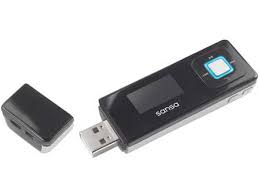
Saturday, June 13, 2009

NTS:: When Sansa's go bad...

[Legal Warning: By following these instructions, you agree not to hold me liable for any bad sh*t that happens to your MP3 player.]


In case this happens again, here's how to un-brick a Sansa Express... in Windows XP, with access to the Administrative Tools (I'm not sure how to do the same in Linux - any ideas?).

I'm unsure how my son's Sansa Express was bricked, but a common cause fro "bricking" is the inability of the Sansa Updater to finish the complete process of updating the firmware. A complicating factor can be the lack of a newer version of the firmware... so you need to have a older version of the firmware on hand [thankfully chrisjs has a copy].

Okay, here's what to do:
  1. Unzip the files from the 7zip file, (see link above), into it's own directory.
  2. Hold the Volume Down - button on the Sansa Express while inserting it into a USB port on your computer, and hold for about 20 seconds.
  3. Release it, and hopefully in Windows Explorer you should see 2 Flash Drive symbols, but when you try to use them, they're empty, and you can't format them either (they're 0Mb in size :])
  4. DON'T PANIC!
  5. In my case, access to the Admin Tools is off the Control Panel - the one that I've used is Computer Management.
  6. Under Storage, click on Disk Management
  7. In the top right panel, locate your dud "Flash Drive"... it shouldn't indicate a file system, because that's what a bricked Sansa looks like...
  8. Right-mouse click on the Disk Drive icon in the left column of that same panel, and you should see the option to format your Sansa - (at this point I can't remember is I used FAT as the filesystem, or FAT32).
  9. Format the Sansa
  10. Then go back to the directory with the unzipped files, and use SansaExpressUpdater.exe
  11. You should find that the Sansa Updater will complete the update, and when the process is complete, the Sansa Express should be un-bricked.

Saturday, May 30, 2009

Thursday, May 21, 2009

Farewell PlantandFood.com, Hi UCOL

Well, I'm in my "break period" between jobs.

I start as the Information Systems Librarian at UCOL on Monday, so I might not be posting much for a little while, while I get my head around Voyager, etc.

I really enjoyed my time at Crop & Food Research, (which merged with HortResearch and became Plant and Food Research 1 December 2008), and then at Plant and Food Research. It was a really interesting place for me, as a librarian, to work: I felt appreciated by other staff, (particularly "the scientists"), I had great people to work with, and there was plenty to get my teeth into! There was also Magic for a while at lunchtimes, and though I seldom won, it was good fun.

So, thanks to all of the exCFR/PFR staff -those who were kind enough to put comments in my card, and for their farewells, and also for the lovely farewell gifts. I really enjoyed my time with you guys, and I hope to keep in touch!

The laptop bag I'm especially chuffed with, since it's also a backpack - great for those times when you're tired, and your laptop seems to weigh a ton! (- no, I don't have a 17" laptop, but I'm optimistic...).


Saturday, May 16, 2009

Librarian-developed/enhanced resources

Okay, I've hinted at this in my last post... in this category would be anything that (any group)/Library/Librarian develops for/with it's clients/users - some examples:

  • OpenURL resolver logged data (and no, I'm not meaning like Ex Libris bX). This is meshed-up data from a variety of web-services which your OpenURL resolver consumes to deliver the data and services which are displayed to Library clients/users as a result of their request.

  • Librarian-developed interfaces - an example being something like a Z39.50 interface to an existing catalogue/dataset which presents the data in a different way... like a more user-friendly interface which shows individual results in more detail, with an OpenURL link to request them (as I demo'd at work to Ann Barrie from NLNZ - I'll post a screenshot if I get time).

  • LinkedData - there's plenty of this stuff being done including on the dataincubator site (no, I'm not employed by Talis, and I'm not sure how many of the people in this group are actually "Librarians")
So, as you can see, it's not just formal/normal "vendors" who provide "information resources". Why does Ex Libris seem to miss this point?

Wednesday, May 6, 2009

Picking fights with giants...

A while ago I picked a fight with Ex Libris, mainly about their EL Commons, mainly on two points (although I'd hoped they'd be moot points now):
1) "I don't think it's appropriate for Ex Libris to promote "El Commons" as part of an "Open-Platform Strategy" though - I think you should promote it as a service to the "Ex Libris community". There's a big difference between the two, and I believe Ex Libris are mis-using the word "open" in this context."

2) I'd "expect that there would be a system where developers, would be able to at least view other developer contributions and either:
- submit details about resources for which they would like Ex Libris to provide adaptors
- provide plugin documentation to create suitable adaptors themselves (if they have "Documentation Center log in details")"
This was following on from an October 2008 post on a Talis blog [ http://blogs.talis.com/panlibus/archives/2008/10/come-on-in-its-open-with-your-ex-libris-key.php ], which ended on the note that:
Well El Commons is up running and accessible at http://www.exlibrisgroup.org. Unfortunately as Oren hinted, you can only enter the commons with your Ex Libris Documentation Center or SupportWeb user name and password – a bit of a misuse of the generally understood idea behind a commons methinks.

What I didn't manage to convey in the last email I sent, (partly because I got bored with them not biting back, and never finished my very last email), was the fact that I thought Ex Libris was overlooking another important information resource - Librarian-developed/enhanced resources.

[more about this later...]

Sunday, May 3, 2009

NTS:: CrossRef alternatives

CrossRef provide a great service with their DOI/OpenURL resolver. There are times however, (esp. since their service was not designed to be a real-time service), goes down, or is unreachable from our network (at work).

Thankfully, you are able to cache the data, as Chuck Koscher recently commented - but what about alternative services?

PubMed is good for recent articles, and other services (such as Web of Science, etc.) are probably no better, unless they have also happen to be able to access the CrossRef OAI-PMH service. You can probably do this search with other NLM databases too.

Example PubMed search:

10.1002/jmv.21494 [aid]

The [aid] is, predictably, the "article identifiers submitted by journal publishers such as doi (digital object identifier). These data are typically used for generating LinkOut links." These include PIIs (Publisher's Item Identifiers), used by Elsevier (and some other publishers). This search can be used as part of a PHP script, such as Alf Eaton's.

On a related note, PMC ids are also appearing in PubMed XML - to link to PubMedCentral with:
PubMedCentral ID (PMCID): http://www.pubmedcentral.nih.gov/articlerender.fcgi?artid=239018
PubMed ID (PMID): http://www.pubmedcentral.nih.gov/articlerender.fcgi?tool=pubmed&pubmedid=2873788

Tuesday, April 28, 2009

Cowtrails and standards

Comparing these two, the first thing you'd notice is that cowtrails are easier to follow... while standards give a sound base.

If you have to implement a service which conforms to a standard though, you need to have something readable, and standards, while normally explicit, don't necessarily go into much detail about the philosophy or thought processes behind them. I suppose there's the expectation that, if you're reading this standard, you're already "there".

I'm not sure about anyone else, but I found, despite comments like "you don't want to know WTF we were thinking" that getting some idea of these thought processes was useful. Admittedly, my experience is limited, and I've heard various comments about the Z39.88-2004 being over-engineered... but once I saw some of the stuff by Jeff Young on his Q6 blog, OpenURL 1.0 made sense.